Hard Fork vs. Soft Fork
Bitcoin’s software is open source, which means that the code is free and available for all to view and utilize. However, for those wishing to participate in the Bitcoin network as a miner, node operator, or wallet administrator, updating and maintaining current version of the Bitcoin software code ranges from important to absolutely necessary.
A “Fork” in programming terms, is an open source code modification. Usually the forked code is similar to the original, but with important modifications, and the two “prongs” comfortably co-exist. Sometimes a fork is used to test a process, but with cryptocurrencies, it is more often used to implement a fundamental change, or to create new assets with similar characteristics.
One thing to bear in mind with forks is that they have a “shared history”. The record of transactions on each of the chains is identical prior to the split.
Soft fork and hard fork
Soft fork and hard fork differ to temporary forks in that they represent a permanent change in the underlying rules of the protocol. Reasons for effecting such a change can occur for various reasons, including:
· Adding extra functionality to the network in the form of upgrades
· Changing a core rule in the protocol, such as increasing the network block size
Soft forks and hard forks differ to temporary forks because changes that are made are permanent, and thus , requires changes at the protocol layers
Soft Fork
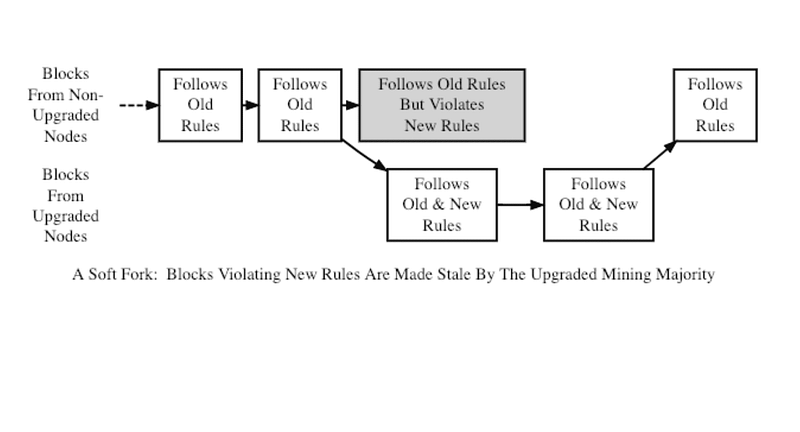
Soft forks are a backward compatible method of upgrading a blockchain. In other words, a soft fork is software upgrade that is backward compatible with previous versions of the software. Soft fork do not require nodes on the network to upgrade to maintain consensus, because all blocks on the soft- forked blockchain follow the old- set of consensus rules as well as the new ones. However, blocks produced by nodes conforming to the old set of consensus rules will violate the new set of consensus rules, and the end results, will likely be made stale by the upgrading mining majority. This is because for a soft fork to work, a majority of miners need to recognize and enforce the new set of consensus rules. If this majority is reached, then the older network will fall into disuse, with the never blockchain gaining recognition as the true blockchain.
An example of a soft fork would be the implementation of a new rule changing the network block size from 1MB to 500KB. Nodes that have not upgraded will continue to see incoming transactions as valid, as these nodes follow the old set of consensus rules as well as the new. However, mining nodes that have not upgraded and attempt to mine new blocks will have these blocks rejected, as it does not conform to the new set of consensus rules. Thus, the blockchain with 1 MB sized blocks is likely to fall into disuse as miners enforces the new consensus rule of 500KB


GOOD
ReplyDeleteNice
ReplyDelete